


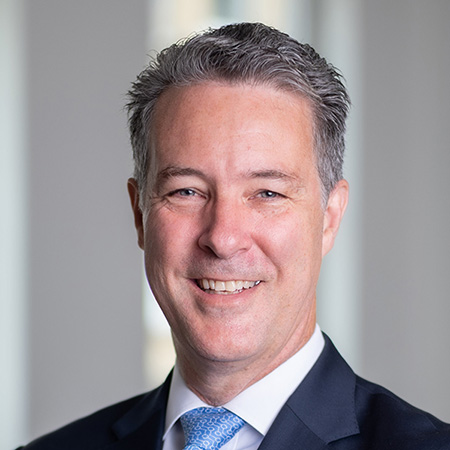
ISDA Chief Executive Officer Scott O'Malia offers informal comments on important OTC derivatives issues in derivatiViews, reflecting ISDA's long-held commitment to making the market safer and more efficient.
Throughout ISDA’s 40th anniversary year, we’ve been reflecting on the quest for greater consistency and efficiency that underpins everything we’ve achieved since 1985. It was at the heart of the original efforts to bring greater standardization to the nascent derivatives market. It’s the focus of our more recent digital transformation work. And it’s the reason why we continue to bang the drum for appropriate, risk-sensitive capital requirements. If the capital framework is disproportionate and inconsistently implemented, economies and companies will suffer from reduced access to funding, lack of hedging and increased vulnerability to external shocks. So, as we look ahead to 2026, the effective completion of the Basel III reforms is at the top of our agenda.
There is no doubt that divergence has emerged between major jurisdictions on the final components of the Basel III framework, including the Fundamental Review of the Trading Book (FRTB), which sets challenging new requirements for market risk capital. In the US, regulators are revising the Basel III endgame proposal following industry feedback, and we expect to see a new proposal in the coming months. In the EU and the UK, the FRTB is now due to be implemented in just over a year’s time at the start of 2027, but the UK Prudential Regulation Authority has proposed delaying the rollout of internal models until the following year.
Meanwhile, the European Commission (EC) launched a targeted consultation earlier this month on changes to the FRTB that would bring some short-term relief in key areas. These would include a set of temporary, targeted amendments to the standardized and internal models approaches, similar to those proposed in an earlier consultation, and the application of a multiplier, which could be used by banks that are negatively affected by the rules to limit the increase in their market risk capital requirements for three years. We’re working with our members to respond to the EC consultation, but, as a general principle, we believe long-term solutions are needed to ensure lasting risk sensitivity, rather than relying on temporary measures.
One of the things the EU, UK and US have in common is a more stringent testing and approval process for banks that want to use internal models under the FRTB – something we think will drive a significant drop in internal modelling. An ISDA survey last year found that only 10 out of 26 banks plan to use internal models for a much-reduced scope of trading desks under the FRTB. That’s a big change that would mean less alignment between risk and capital and less diversity in models. It could also lead to herd behavior and drive concentrations in particular assets. While the FRTB standardized approach is designed to be more risk-sensitive than previous versions, its calibration will inflict the highest capital increases on those banks with large, diversified portfolios.
ISDA has recommended changes to improve the incentives to use internal models, which would require the recalibration of certain elements of the FRTB, including the profit-and-loss attribution test, the risk factor eligibility test and non-modellable risk factors. I’m pleased to say we’ve had very productive engagement with policymakers in recent months, particularly in the US. We’re hopeful that revisions to the US Basel III endgame will make internal models a more viable option than in the original proposal.
The completion of the Basel III capital framework has been a long time coming and fraught with complex challenges, but we can’t afford to lose focus. The preservation of deep and liquid capital markets depends on our continued commitment to risk-appropriate capital requirements. As the EU, UK and US move to finalize their rules, ISDA will continue to engage closely with policymakers to ensure we achieve a robust capital framework that is truly fit for purpose.
Latest
ISDA DTF Hong Kong: Steven Kennedy Remarks
ISDA Derivatives Trading Forum Hong Kong November 12, 2026 Opening Remarks Steven Kennedy Global Head of Public Policy, ISDA Good morning, and welcome to the ISDA Derivatives Trading Forum. It’s great to be here in Hong Kong – thanks for...
2026 FX Definitions: Act Now
On November 22, 2027, the 2026 FX Definitions will come into effect. From that point, these definitions will become the market standard for all cleared and new non-cleared FX derivatives, and the Swift messaging service will halt its support of...
IRD Trading in Mainland China and Hong Kong
This report examines interest rate derivatives (IRD) trading activity in mainland China and Hong Kong in the first half of 2026. Onshore renminbi (RMB) IRD traded notional in mainland China rose to $3.4 trillion in the first half of 2026,...
ISDA In Review – October 2026
A compendium of links to new documents, research papers, press releases and comment letters published by ISDA in October 2026.